Math Facts & Number Sense
Below is adapted from the video.
If you want the full context PLUS all the visuals I shared, watch the video.
There’s no debating that we want kids to be quick with their addition and multiplication facts. But there IS a lot of debate about how we get them there. Some folks believe we should just drill kids on their facts. Others believe we should just let kids play and discover.
The research says… neither of those.
Fast OR flexible isn’t the goal
For nearly 20 years, I’ve been talking about the need to help kids build their number sense, because flexibility wasn’t part of our fluency work. We used to focus only on getting kids faster and more accurate.
But now the pendulum has swung, and for some people the ONLY fluency work happening is flexibility.
The goal isn’t kids who are fast. The goal isn’t kids who are flexible. Kids need all three pieces of fluency to be truly fluent: accuracy, efficiency, and flexibility.
Where derived facts fit in
I’m grounded in the work of Cognitively Guided Instruction (CGI). The idea is that kids naturally move through stages as they develop strategies, and some kids are more inclined to develop what are called derived facts.
A derived fact is when a kid doesn’t instantly know a fact, so they figure it out from something they DO know. If I don’t know 3 + 4, I might know 3 + 3, and that helps me out. If I get stuck on 6 × 7, I can ask myself, “Hmm, what do I know that could help me here?”
Some kids see those connections naturally. Other kids need our help to see them.
Kids in the direct modeling and counting stages are often VERY accurate. They count everything, sometimes double and triple counting. But they aren’t efficient, and they aren’t flexible thinkers. There are also kids who are accurate and efficient but have no flexibility at all. Up at the top of the progression is where we see all three, and that’s where derived facts come in.
This isn’t just my opinion
What I’m sharing comes from the IES/What Works Clearinghouse practice guide, Assisting Students Struggling with Mathematics. There was a 2009 version; I’m pulling from the updated version released in 2021.
Here’s why I go to this guide. You can find a study here and a study there that says we should do this or that. This guide is a compilation of high-quality research, and its six recommendations are backed by strong evidence. And while it’s written for students who are struggling (Tier 2 and Tier 3), these recommendations work in Tier 1 too, so fewer kids end up needing intervention in the first place.
I can’t dig into all six here, so I’m focusing on one: systematic instruction.
Let’s talk about “explicit,” too
Everyone seems to have their own definition of systematic instruction, and we need to get on the same page. I’m also bringing in the word explicit. In the 2009 version, the recommendation was “explicit and systematic instruction.” In 2021 they dropped “explicit.” I think that’s mainly because the word is controversial. But I don’t think it should be.
Sometimes the easiest way to define something is to look at its opposite. The opposite of explicit is implicit, which dictionary.com defines as ideas that are suggested, hinted at, or understood without being directly or plainly stated.
You guys, we do NOT want to be implicit. We can’t assume kids are seeing what we see, or what another kid sees. We need to call it out. We need to plainly state it, so everyone sees the connections we’re trying to build with them.
Piece 1: Be sequential (don’t willy-nilly it)
Systematic means there’s a sequence. We can’t just bounce from this fact to that fact to the other fact. There needs to be a system in place.
Now, your system might look different than mine, and that’s okay. I’m not here to sell you a fact program. I want to give you the research so you can look at whatever you’re currently using and make some judgments about it. Is there a sequence? Is it actually following something?
My addition sequence

I like to start with accessible numbers, not 7 + 8. Kids naturally gravitate toward doubles, so that’s where I start. Then make a ten, then plus zero and plus ten. (I don’t start with plus zero, because adding nothing is really weird to young kids. And if you’re in kindergarten, you’re only working within 10, so you’ll focus on doubles within that number set.)
Notice I don’t start with plus ones, then plus twos, then plus threes. I start with the facts that make sense to kids and that CONNECT to other facts. Knowing doubles helps with doubles plus or minus one. Knowing 7 + 3 helps with 7 + 2. But only if we’re explicit about it, because not every kid sees those connections on their own.
My multiplication sequence
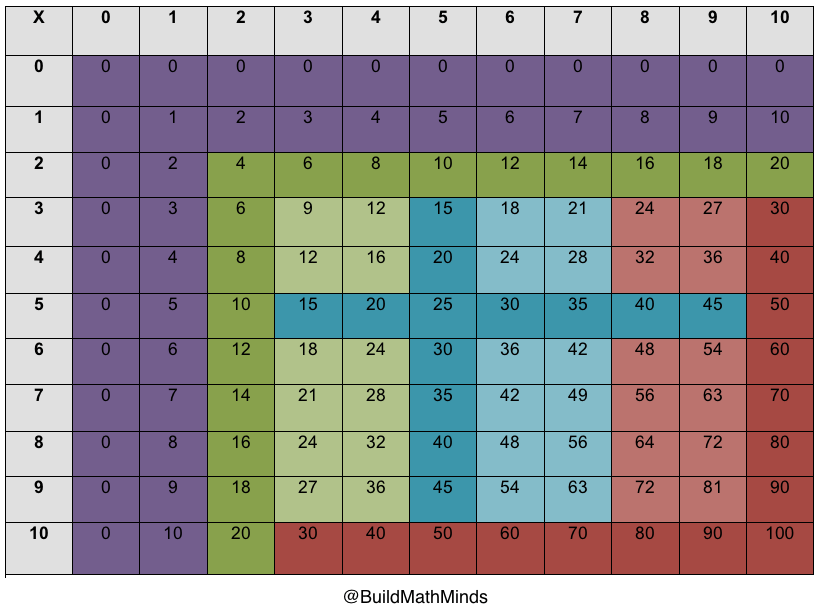
For multiplication, I like times twos, times tens, times fives, and then zeros and ones. I don’t start with zeros and ones because those are really properties, and multiplying by zero is just weird if you don’t have a foundation of multiplication yet.
I start with times twos because it lets us do another thing the guide calls for: review and integrate previously learned content. Times two is your doubles addition facts! If you still have kids who struggle with addition, you get to bring that practice right along.
You could go to fives next, but what I’ve found is that kids are REALLY fast at skip counting by fives without understanding what they’re doing. So I go to times tens first. And times ten is more than “just add a zero.” That’s what kids see happening, but you’re actually making the number ten times bigger. (That matters later when they multiply decimals.)
Then when we get to fives, we connect them to tens: times five is half of times ten. And that lasts long term. For 12 × 5, I don’t have to skip count. I know 10 × 12 is 120, so 12 × 5 is half of that. Twos then help with fours, and even eights.
Again, you don’t have to use my sequence. Look at what you’re using through this lens:
- Am I starting with accessible numbers?
- Am I integrating previously learned content?
- Am I connecting facts together?
- Is there actually a system?
Piece 2: Provide visual and verbal supports
7 × 6 isn’t just symbols. In the United States, we tend to say multiplication as “seven groups of six.” A lot of adults only know 7 × 6 = 42 and don’t realize it actually means seven groups of six. We need to attach that verbal piece.
Once kids understand it as seven groups of six, the visual is SO powerful. Now I can break it apart any way I want. I can see five groups of six and two groups of six and put them together.
But here’s where explicit comes back in. When one kid shares that strategy, other kids are sitting there thinking, “What?” So we say, “You’re saying seven groups of six is the same as five groups of six and two groups of six? Where do we see that in the visual?” Point it out. Make sure everyone is on the same page. Then write it the way mathematicians do, at your students’ level.

Piece 3: Give feedback
The final piece of systematic instruction is feedback. We need to tell kids when they’re wrong. We can’t just leave them working on their own.
And feedback isn’t a red check mark or “Nope, you’re wrong.” It’s “Not quite. Tell me how you did that. What are you seeing?” Dig in, find where that wrong answer came from, and support them along the way.
Number sense is the root system
So how do we get kids into that derived fact and fact stage? It comes from the number sense we build. The early numeracy concepts (subitizing, verbal counting, object counting, and cardinality) are where it all starts. Then we move kids past counting into seeing relationships: spatial relationships, one and two more or less, benchmark numbers, and part-part-whole.
Picture a fact like 6 + 7. If all a kid has is “6 + 7 is 13,” there’s no root system. When the storm hits, it blows away.
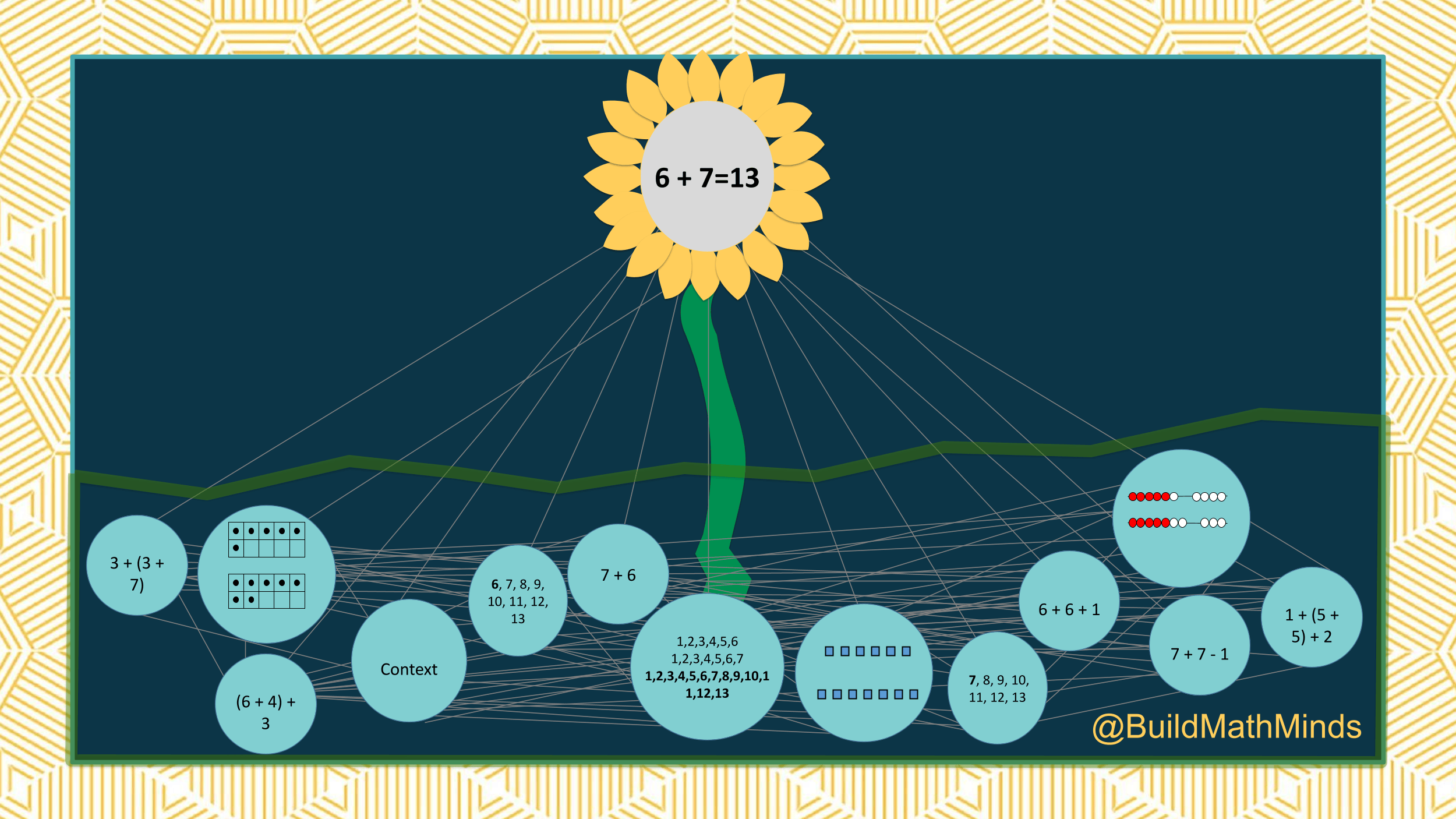
Kids need roots: counting, visuals, context, an understanding that order doesn’t change the sum. Then a couple of strategies start to grow. Kids don’t need EVERY strategy for 6 + 7. They need a couple, so that if they forget, they have something to come back to. And when we help them connect those pieces, the root system gets strong. Research on the brain tells us that the more connections we have to something, the easier it is to recall later.
It’s not the strategies we have to teach. It’s the relationships. If a kid says 4 × 6 is close to 5 × 6, that only makes sense if they understand it’s one GROUP less, if they can visualize it, and if they understand part-part-whole. Teaching a pile of strategies to kids without number sense is overwhelming and confusing, and it turns strategies into one more procedure to memorize. Build the relationships, be explicit about them, and kids start developing strategies on their own.

A quick word on timed activities
One of the six recommendations is timed activities. Not timed tests. Timed activities. And the guide includes some qualifications:
- Don’t time every single day. Kids need instruction in between so they actually get better.
- Don’t time facts kids don’t yet have efficient strategies for.
- It should never be demeaning or punishing. Timing should motivate kids and help them see their own growth.
We can’t go back to daily mad minutes and keeping kids in from recess. Kids can work on doing as many as they can in a time frame without having to hit some benchmark in a minute.
Pulling it together
Keep letting kids count. Do lots of subitizing. Use context and LOTS of visuals. Be explicit about the relationships: highlight them, talk about them, make sure everyone sees them. And still give kids practice. All of this is spelled out in the practice guide, and when we bring it into Tier 1, fewer kids need Tier 2.
Want to go deeper?
If you want your students to be thinkers, not just memorizers, who see these number relationships in their facts and in all of math, come join my online course, The Flexibility Formula. The PreK–2 course walks you through all eight number sense concepts, what to look for to see if your students understand them, and the experiences that build those relationships. The 3–5 course does the same for multiplication, division, multi-digit whole numbers, and fractions.
You can join at buildmathminds.com/enroll. And if you want your whole school on the same page, reach out about group pricing.
I hope this helped build your math mind so you can build the math minds of your students.
 Welcome! I’m a Recovering Traditionalist elementary teacher and now, I help teachers and children learn to love math. Explore how I can help provide you PD at your fingertips! BuildMathMinds.com